How Evaporation Works in Timberborn - and How to Reduce It
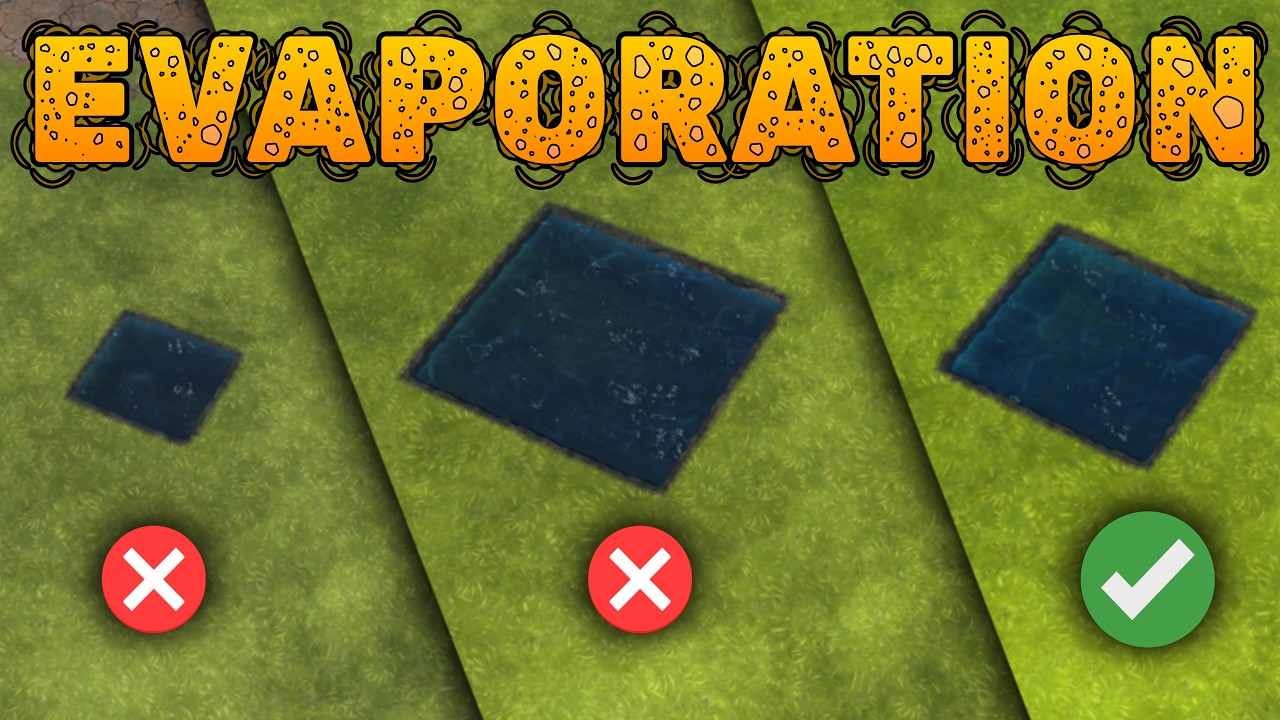
Evaporation in Timberborn can seem mysterious. Water sometimes evaporates in places where you might not expect it to, and covering a reservoir doesn’t necessarily stop it. That’s because the game simplifies the process rather than simulating every real-world factor.
Still, understanding the rules can help you make your water last longer. Here’s how evaporation works, what overhanging terrain can change, and why shorter canals are often better than wider ones.
How the game calculates evaporation
The game assigns an evaporation value to water based on the surrounding tiles. In general, a water tile with fewer neighboring tiles exposed to it contributes more to evaporation. That’s why a small, isolated pool can disappear quickly, while water in a larger reservoir tends to last longer.
A useful rule of thumb is that the top layer of a reservoir is where evaporation happens. Greater depth acts like a multiplier: there’s more water to lose before the reservoir dries out. For example, if a 3×3 reservoir that is one tile deep takes about 10 days to evaporate, making it two tiles deep would roughly double that to about 20 days.
The relationship isn’t quite as simple as “deeper is always better,” though. The number and arrangement of exposed water tiles still matter.
Does covering a reservoir prevent evaporation?
Nope! Covering water with impermeable floors does not appear to reduce or increase evaporation. Even enclosed or covered water can still lose water according to the game’s evaporation rules.
That may feel unintuitive, especially for water stored in enclosed pipes or reservoirs, but it’s how the game currently behaves.
Why longer canals evaporate a little less per tile
A short, straight canal has more exposed end tiles relative to its total length. As a canal gets longer, more of its tiles have neighboring water tiles on both sides, which reduces evaporation from those tiles.
The improvement is most noticeable in the first few tiles. Making a canal longer can help, but the benefit quickly diminishes.
Overhanging terrain can also expose water in unexpected places. If water collects beneath a terrain overhang, those extra exposed water tiles can contribute to evaporation: even when the main reservoir looks like a simple, full 3×3 pool. This can make one reservoir drain faster than another with the same surface dimensions.
Are wider canals more efficient?
Widening a canal can reduce evaporation per water tile, but it also creates more water tiles that can evaporate. As a result, the total water loss may not decrease; and can even increase.
Comparisons between one-, three-, and four-tile-wide canals show that wider canals do not necessarily preserve water for much longer. Much of the apparent difference can come down to what happens when the reservoirs reach their final remaining layer of water.
The Timberborn Wiki’s evaporation calculator makes the tradeoff easier to see. In one example, a seven-tile, one-wide canal uses about 1.5 tiles of water per day. Extending it raises that figure to around 2.7 tiles per day. Widening the canal reduces evaporation per tile, but a three-wide canal still uses about 2.37 tiles of water per day. Adding another layer of water can push the total evaporation even higher.
The calculator also shows that, for a one-wide canal, increasing the length may make the water last only up to about 12% longer: not several times longer.
And increasing a canal to four tiles wide is especially unlikely to be worthwhile.
The practical takeaway
When you’re trying to conserve water, prioritize shorter canals over wider ones. Widening a canal can reduce evaporation on individual tiles, but the additional exposed water often cancels out that benefit.
Also keep an eye out for water collecting beneath overhanging terrain. Those hidden pockets can add evaporation you might not have accounted for. And while making a reservoir deeper gives it more water to draw on, depth doesn’t eliminate the underlying evaporation.
In short: keep your water routes compact, avoid unnecessary exposed water, and use the evaporation calculator when you’re planning a large reservoir or canal network.